
Outstanding Warrants in Connecticut
Connecticut's Judicial Branch warrant page covers a limited group of VOP, FTA, and OTI warrants. That is not every active criminal warrant. The pending criminal and motor-vehicle lookup shows court information and public docket events, not an all-warrant register, and police-requested warrants with agency service records can sit outside both views. No single public code defines 'active' or 'outstanding' in Connecticut. The words usually mean a warrant was issued and is not recorded as served, recalled, or quashed in the system being checked. The issuing Superior Court confirms judicial status. Local police or CSP can speak to service activity. There is no county sheriff warrant desk.
Connecticut Has No Complete Warrant Register
Each public tool answers a different question. PRAWN supports authorized warrant inquiry and electronic custodial processing for agencies, with no resident login or public search account. COLLECT, CISS, and NCIC are restricted criminal-justice channels in Connecticut, not public directories.
| Channel | What It Can Help Show | What It Cannot Confirm Alone |
|---|---|---|
| Judicial Branch VOP page | Limited VOP, FTA, and OTI public lookup by name, town, or court location. | Every warrant type, current service status, or FTA warrants while the notice suppresses them. |
| Pending case lookup | A displayed case, court location, category, and public docket events. | A warrant flag or proof an order remains active or has been served. |
| PRAWN and other justice systems | Authorized criminal-justice inquiry and operational processing. | A resident self-search or public statewide register. |
| Local police or CSP | Records and service information within that agency’s scope. | Another agency’s file or the court’s final judicial status. |
| USMS or DOC program pages | Information about a distinct federal or parole-fugitive program. | A complete Connecticut warrant search. |
A portal can omit records by design. Connecticut's restricted agency systems are no public substitute, so confirm any possible warrant with the issuing court and the responsible police agency.
The Connecticut Active-Warrant Picture
The Judicial Branch page covers VOP, FTA, and OTI matters. It is not every criminal or police-requested warrant in Connecticut. A live notice on the Connecticut page says FTA warrants will not be displayed until further notice. Entries are also withheld when publication could endanger someone or involve youthful-offender proceedings. A surname of at least two letters is required. Optional fields include town, court location, first-name prefix, birth year, and a plus-or-minus birth-year range. No county, agency, charge, bond, case-number, status, or issue-date filter exists. The town menu reflects Connecticut court geography, not the agency that will serve an order. The 'accurate as of' timestamp is no list-wide refresh promise. It is not proof each agency sent every change. A served or recalled matter can linger until an update lands, and a missing name may reflect scope limits, safety rules, or FTA suppression on the Connecticut list. No export, result count, pagination, or refresh schedule appears. The VOP/FTA/OTI page posts the live notice and its search fields. A match is a reason to ask the issuing court about Connecticut warrant status, not proof of any service action.
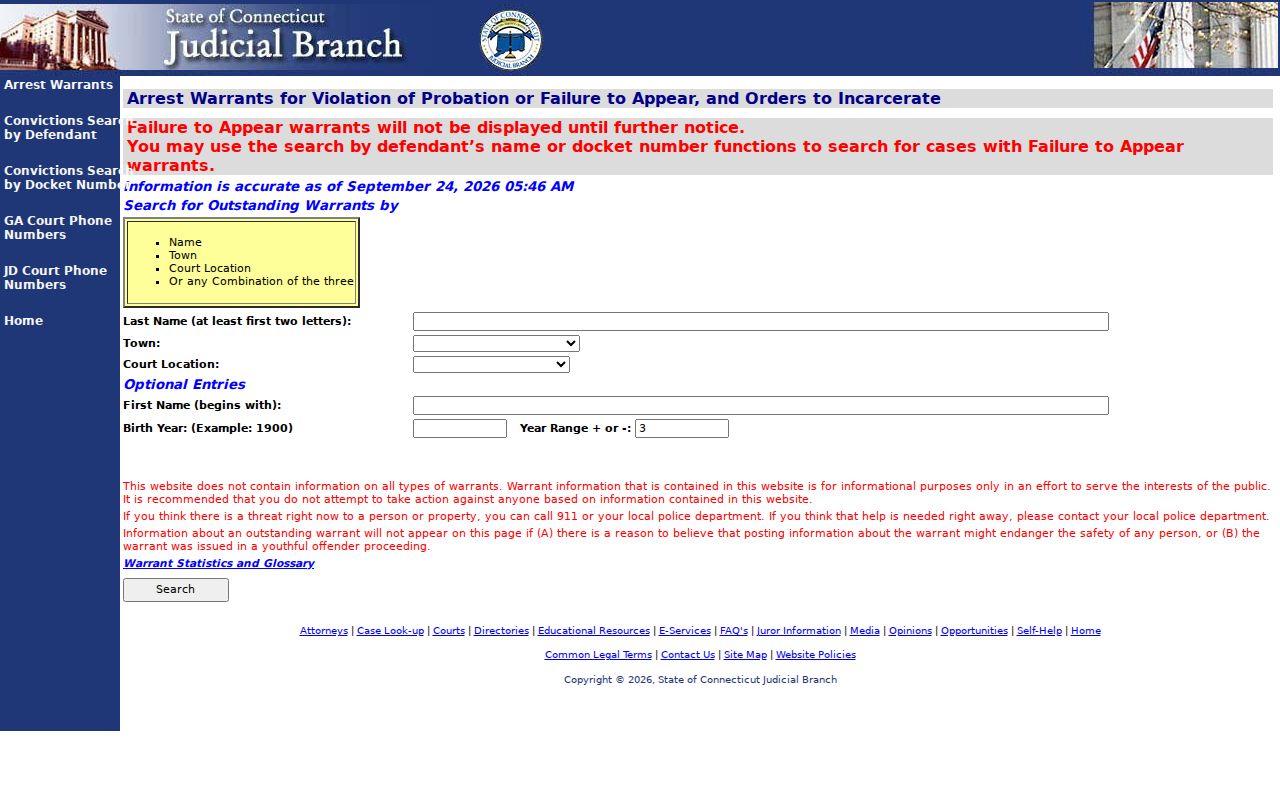
The bare Connecticut search interface shows how narrow the public tool is. It displays no individual warrant record and promises no routine refresh cycle.
Connecticut Warrant Statistics Are Not Live Counts
Connecticut's Judicial Branch publishes quarterly failure-to-appear statistics. They summarize one reporting period. They are not a live count. The reports cannot tell you whether an individual Connecticut warrant remains active, and their aggregate court and issue-date fields do not describe every public result. Never treat a historical total as the number of Connecticut warrants outstanding now, and never combine periods. The timestamp and the reports serve different purposes. Neither promises record delivery to local police. For a case-specific answer, treat the docket as a lead, call the assigned GA or JD clerk, and verify service separately with the responsible police department or CSP. The quarterly FTA reports provide period-based context, not individual active-warrant status.
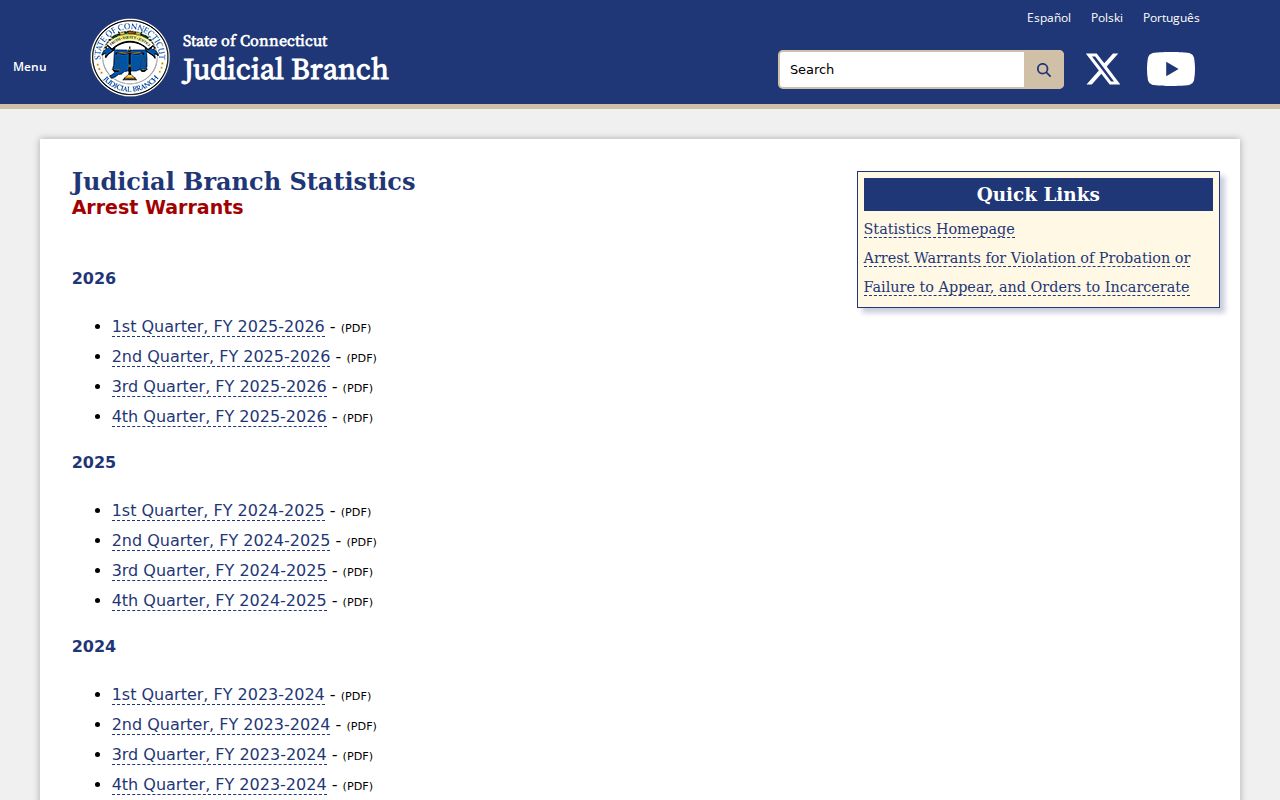
Treat those quarterly figures as history only. For an individual status question in Connecticut, the issuing clerk and the responsible agency are the channels.
Active Warrants: What They Show
Connecticut sets no public warrant-number format. It publishes no universal warrant schema either. The VOP statute permits specified details for that category, and quarterly reports carry aggregate fields, so neither fixes what every entry displays.
| Name and address | May appear in information authorized for the VOP page; no individual sample was inspected to confirm a particular result. |
|---|---|
| Issuing court and date | Quarterly reporting describes these fields, but an aggregate row is not a live warrant record. |
| Docket number | Identifies a court case and helps a clerk retrieve it. It is not a warrant ID. |
| Charge and bond | Not confirmed as standard public portal fields. Ask the court about the specific file. |
| Status and service | No public statewide status-code dictionary or universal update date was found. Confirm with court and agency. |
Read 'active,' 'recalled,' 'served,' and 'quashed' as plain descriptions unless the official Connecticut record defines them. A blank field does not mean no bond, and a docket number is not a warrant number.
Connecticut Fugitive Programs Are Not Warrant Rosters
Connecticut State Police publishes no 'Top Ten' warrant roster on its DESPP pages. A case press release is not a warrant list. Local police notices vary from town to town. There is no cross-town index or promised update schedule, and absence from an agency site proves nothing about warrant status. The Connecticut DOC's Parole Fugitive Investigations Unit handles parole absconders, community-supervision escapees, and assigned cases. The U.S. Marshals Connecticut Violent Crimes Fugitive Task Force has a federal fugitive mission. Its district page is not an exhaustive state search. Neither replaces a court docket or service record. CSP's public investigative-information route accepts tips about criminal investigations, not warrant-status questions. Its separate text-tip page notes that texting is unavailable. Neither route is a fugitive roster, or a substitute for asking the Connecticut court and serving agency about a personal case. The DOC unit page describes a parole-supervision remit, not general Connecticut warrant status.
A Connecticut fugitive program targets people who fled supervision, and its notices serve that mission. A tip line or program page is not a warrant list, and it confirms nothing about a specific court order.
Official program link: The U.S. Marshals District of Connecticut page describes its task force and current profile availability. The DOC Parole Fugitive Investigations Unit is specific to its parole and community-supervision mission. Neither is a complete state warrant list.
Connecticut Warrant Roundups
Connecticut runs no statewide warrant roundup, no amnesty event, and no reward schedule. Federal task-force work is a different animal. It is not a batch-clearance sweep by the state. One U.S. Marshals release counted more than 11,046 cumulative arrests by the Connecticut Violent Crimes Fugitive Task Force through September 8, 2022, but that dated figure is task-force history rather than a count of today's active warrants. Rewards tied to a specific federal case follow that case's terms. They are not a Connecticut program. A local operation or press notice does not prove every outstanding warrant was included or cleared, either. The historical USMS release offers context, while current program details sit in the official district source above. For an individual matter, confirm service, recall, and bond conditions with the court and agency that hold the record.
Connecticut Warrant Checks Route by Town
Connecticut warrant checks route by town, not county. The state has no county sheriff tier, so a directory's city, town, and historic-county routes orient you by place rather than mapping 27 county governments. Start with the municipality. Find its Superior Court GA or JD. Then identify the local police department or CSP troop involved. A historic county label will not name the warrant custodian. Browse Counties gives the geographic path to those local destinations, but once there, look for town court and police contacts instead of a county warrant office. The Judicial Branch VOP form's town and court-location menus reflect the same court geography, not county coverage or service maps. DESPP takes State Police record requests through its Reports and Records channel under Connecticut's FOIA, including C.G.S. §§1-210 and 1-215. A report request, though, is not live warrant status. For criminal process, call the clerk and the assigned police or CSP agency.
Finding Your Own Name on a List
A name on the Judicial Branch page is a lead, not an answer. Open the pending case lookup and note the docket plus the GA or JD. Then ask the clerk directly whether the warrant is still active, what hearing or motion is required, and what bond terms apply. The court directory will locate that clerk. Ask the identified police agency or CSP about whether the warrant has been served. Connecticut has no county sheriff's office you can call for statewide confirmation. A blank search is not clearance either. FTA suppression, safety and youthful-offender exclusions, sealed material, and limited portal coverage all skew results. A criminal or MV docket is not the official record. Federal matters belong in federal court and with the USMS, not the Connecticut portal.
Important: Before arranging a surrender or appearance, speak with a lawyer and confirm the current order, bond or release terms, and recall process with the issuing court.
A lawyer can walk you through a recall or quash request, a voluntary appearance, or bond under the rules for your case. Court action is only half the job. Afterward, ask how the order reaches the serving agency, and confirm its own record shows the update.
Why Connecticut Warrant Searches Miss Records
A blank result can mean several things. The matter may fall outside VOP scope, an FTA warrant may be suppressed, a safety or youthful-offender rule may apply, or the record may be sealed. A docket may not flag a warrant at all. Local police may keep no public list. The portal timestamp proves nothing about every custodian sending updates, and Connecticut sets no statewide refresh schedule. Connecticut FOIA can support a request for a releasable agency record, subject to exemptions, while court files follow Judicial Branch access rules. C.G.S. §1-215 creates no public index of unserved warrants. Ask the clerk about the official file and police or CSP about service. Check ticket and DMV matters separately through the CIB ticket portal, the court, or the DMV suspension channel. Public PACER or RECAP material may show a filed federal case, but sealed or unfiled warrant material stays hidden. USMS district information is not state warrant confirmation. A missing portal entry never proves a warrant does not exist or was cleared.