
How Traffic Warrants Work in Connecticut
A Connecticut traffic ticket arrives with an answer date and instructions: pay the fine, enter a plea, or contest it. When a hearing is required, a Superior Court Geographical Area, or GA, takes the case. Ignore the answer date and the consequences split apart fast. The court may issue an order, file a separate failure-to-appear charge, or trigger a license consequence, depending on the matter. Not every unpaid ticket ends in an arrest warrant. And a Connecticut DMV notice by itself proves nothing about one. Before calling anyone, gather the paper. Keep the ticket number, the answer date, and any Connecticut court notice you received. The docket on that notice identifies the clerk who can confirm judicial status. For service status, local police or Connecticut State Police hold the answer, so check both when the court order is the worry.
Connecticut Traffic Warrants Use Superior Court
Connecticut runs one criminal trial tier, not a patchwork of city or municipal courts, and no justice-of-the-peace warrant desks. The Centralized Infractions Bureau, or CIB, handles eligible tickets; plead not guilty or face a required appearance, and the case moves to its assigned Superior Court GA. Major criminal matters can land in a Judicial District court instead. Hartford and Waterbury Community Courts are Superior Court locations, not city warrant desks. A ticket's town tells you where the stop happened; the docket tells you which court actually holds the case. An old county name names no current court. The Judicial Branch's court overview lays out how the Connecticut system fits together.
How Connecticut Flags a License Hold
Connecticut has no statewide OmniBase-style program that turns a traffic warrant or failure to appear into a license hold. What it has is narrower. Under the Connecticut General Statutes (C.G.S.) §14-140, a qualifying court report after certain failures to appear, pay, or plead prompts the Department of Motor Vehicles to send a suspension notice. That notice speaks to driving privilege only. It says nothing about the court docket or any warrant. A clean license status, in other words, cannot certify that no Connecticut warrant exists.
| Channel | What It Shows | What It Does Not Show |
|---|---|---|
| Connecticut court report under §14-140 | A qualifying motor-vehicle default reported for DMV action | A complete Connecticut warrant listing |
| Connecticut DMV suspension status | Whether a license is suspended or restored | The court's current warrant or bond order |
| Connecticut Superior Court docket | Public case events and status where available | A guaranteed warrant registry or service record |
| Connecticut public VOP page | A limited set of violation-of-probation (VOP), failure-to-appear (FTA), and orders-to-incarcerate (OTI) matters, with exclusions | All traffic warrants; FTA display is currently suspended |
Note: A license suspension and a court warrant can grow from the same missed date, yet each has a separate record keeper and confirmation path.
Connecticut Traffic Warrants and DMV Notice
Under C.G.S. §14-140, a qualifying Connecticut report generally opens a 60-day window to reopen the case before suspension takes hold. Public Act 25-159, §60, effective October 1, 2025, revised that notice to include a motion and a fee-waiver request. Once a Connecticut ticket case is reopened, Superior Court tells DMV electronically. The money side has two doors. The court may waive its $40 Connecticut reopening fee, while a suspended license carries a separate $175 reinstatement fee at DMV. Court fees go to the court; restoration goes to DMV. Neither payment settles a separate FTA charge or proves a warrant was resolved. The Connecticut DMV suspension instructions cover the notice and the reopening steps in full.
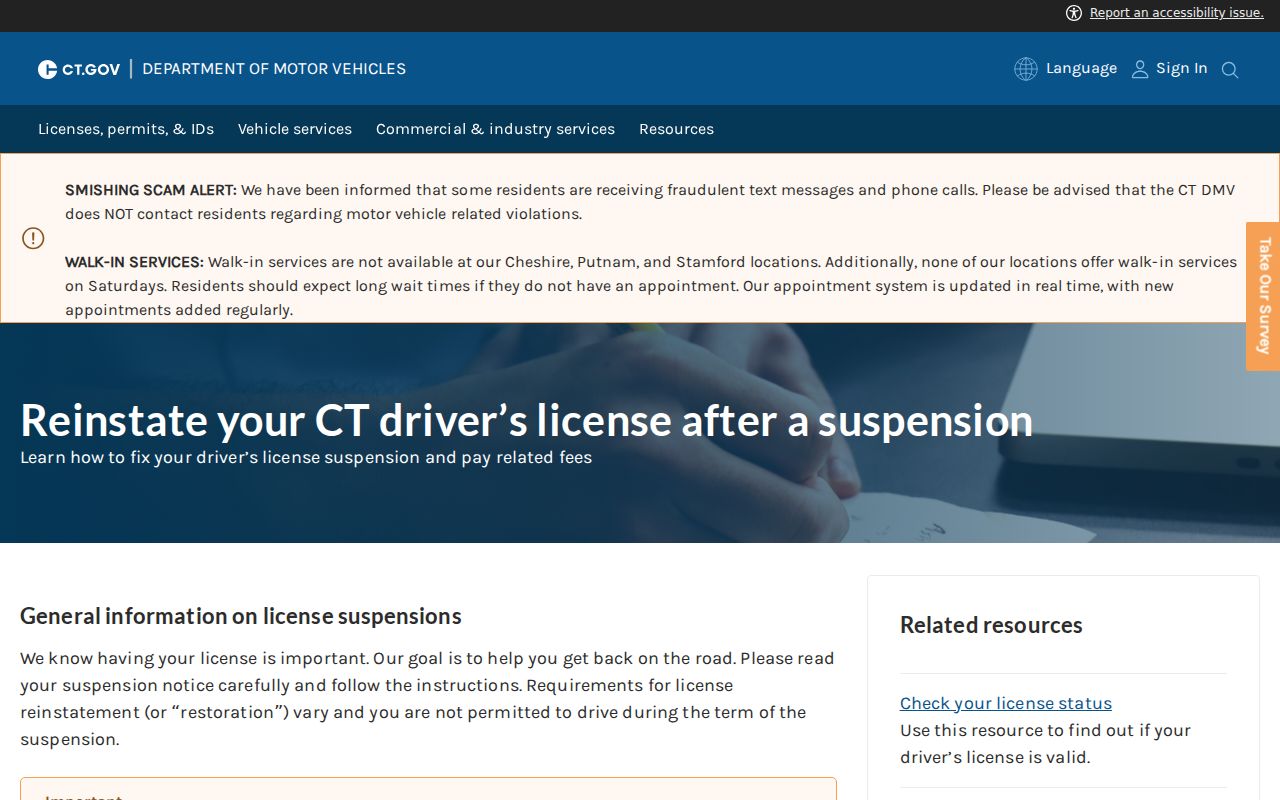
The notice covers driver status only. It cannot replace a clerk's word on any related warrant or court order.
Connecticut Traffic Warrant Checks
No Connecticut public search lists every traffic warrant. So work from the ticket or docket, and ask the assigned Superior Court Clerk's Office for the current order. For service, ask which local police or CSP unit holds it. DMV confirms license status, not warrants.
- Use the ticket number and answer date to identify the citation; the town can narrow the local records contact.
- Check CIB for a ticket response or the public docket for case events. Neither is a complete warrant search.
- Find the assigned Connecticut GA or JD Clerk's Office in the Judicial Branch directory and ask if process was issued or recalled.
- Ask which police or CSP agency holds the service record, then confirm with that agency.
- Use Browse Counties only for geographic orientation; Connecticut's historic counties are not courts or sheriff jurisdictions. Route by town and assigned court.
A family member's notice can reveal the docket. DMV status will not. An attorney can judge whether an appearance or motion fits. The county directory is just a map; use the Connecticut court named on the case.
Connecticut Traffic Warrant Search Channels
Different Connecticut channels answer different questions, so pick the one that fits yours. Some track ticket responses, others show public docket events or license status. The state's public page currently reports that failure to appear warrants stay off display until further notice, so one blank result proves nothing. A thorough Connecticut warrant search may take more than a single source.
| Channel | Access and Use | Limit |
|---|---|---|
| Connecticut CIB ticket lookup | Ticket number plus check digit, and the first three letters of the last name or company name; select Find. | Ticket response and payment path, not warrant status. |
| Connecticut criminal and motor-vehicle case lookup | Search by last-name prefix; optional first initial, birth year, court, and case category narrow public docket results. | Not the official court record or a warrant registry. |
| Connecticut public VOP, FTA, and OTI page | Public form uses name, town, and court location. | FTA warrants are temporarily not displayed; other exclusions apply. |
| Connecticut DMV status | Check license suspension and restoration instructions. | Does not report court warrant status. |
| Connecticut clerk and law-enforcement records | Ask the assigned court clerk about the order; local police or CSP about its service record. | A records request is not a live status search. |
The Connecticut CIB ticket form shows a blank ticket-number and check-digit interface for responding to a citation. Warrant or recall questions still go to the Connecticut court.
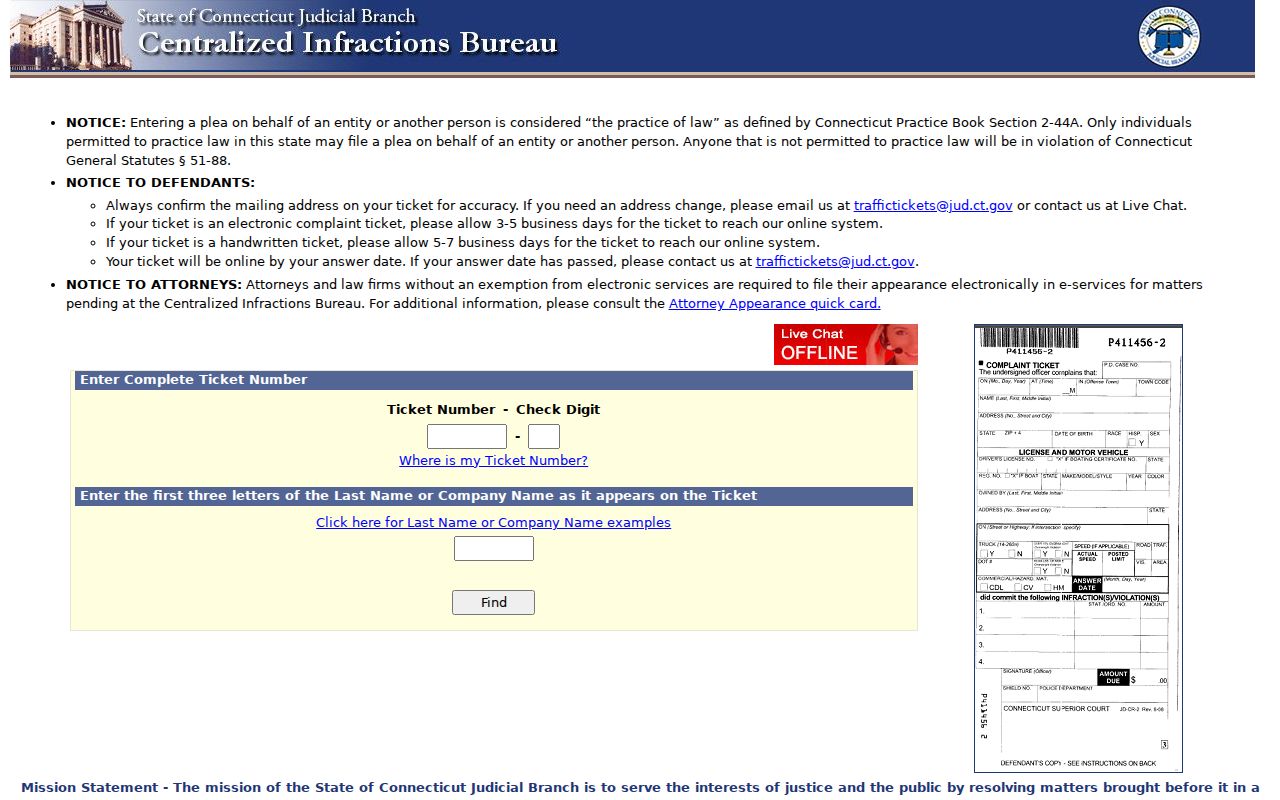
That empty form holds no one's case information; its fields identify a ticket, not a warrant record. For police-side material, request eligible records under the Connecticut Freedom of Information Act, C.G.S. §§1-210 and 1-215. Connecticut DESPP takes certain CSP incident and investigative-report requests through GovQA; its $16 fee covers reports, not warrant confirmation. Current status comes from the court. Note: The Paperless Arrest Warrant Network (PRAWN) and other restricted justice systems serve authorized agencies; Connecticut residents have no public login.
Clearing a Connecticut Traffic Warrant
In Connecticut, a traffic warrant is resolved with the court that issued it. Paying through a ticket channel may address the citation yet prove nothing about a separate charge or warrant. Ask the Clerk's Office whether the case needs a motion, a new date, an appearance, or another step. Bond is case-specific; no statewide schedule or pay-or-lift form exists.
- Use the ticket or docket to identify the Connecticut court and case.
- Ask the Connecticut court if a warrant or separate FTA charge exists and what step is required.
- Keep the signed order or receipt; ask the police agency how its service record will update.
- For suspension, complete DMV restoration separately and confirm license status.
Caution: Paying a ticket or DMV reinstatement fee does not prove that a separate Connecticut court warrant has been recalled; confirm with the court and service agency.
Note: Connecticut traffic-warrant status and license status are separate, so confirm with both the assigned court and DMV.
Connecticut Traffic Warrants After a Missed Date
A Connecticut ticket that has not shown up online near its answer date is not an extension. Treat the deadline as live. The Connecticut Judicial Branch expects the ticket to appear by its answer date, and it estimates 3 to 5 business days for electronic tickets and 5 to 7 for handwritten tickets to reach CIB. If the date has passed or is close, call (860) 263-2750 or email traffictickets@jud.ct.gov. Ask the assigned Connecticut court what is due. When you search CIB, have the ticket number and check digit ready, plus the first three letters of the last name or company name. One limit matters here. CIB has no warrant-status filter, so the notice or docket is what tells you whether the matter is still a ticket response, has a hearing, or carries another court order. A late entry and a missed legal deadline are two different problems. If suspension is the worry, read the DMV notice's effective date and ask the court about reopening. Once a suspension takes effect, confirm DMV restoration separately. Keep every Connecticut record you get.
Connecticut Traffic Warrants: Fee and DMV Split
Three different numbers get confused here. A Connecticut citation fine is one thing, the $40 court reopening fee under §14-140 is another, and DMV's $175 reinstatement fee after suspension is a third. The court may waive reopening fees. Paying DMV restoration in Connecticut does not post a warrant bond, and it does not ask a judge to recall a warrant. If Connecticut court process or a separate FTA charge is pending, ask the Clerk's Office whether more action is needed. Bond terms depend on the order. Keep your receipts, then confirm status with the docket and the responsible police agency.
- Court reopening fee
- $40 under §14-140; ask the court whether it will waive the fee.
- DMV reinstatement fee
- $175 after suspension, paid to DMV under its instructions.
- Warrant bond
- A Connecticut court-specific release condition, not a flat statewide traffic fee.
Connecticut Traffic Warrant or Driver Record
These records answer different questions. A Connecticut traffic warrant, a ticket docket, and a DMV license record are not interchangeable. Court records cover the citation, hearing, judgment, or judicial order. DMV records cover driving privileges. License status does not establish whether a Connecticut judge issued or recalled a warrant, and court action does not prove DMV has updated the license.
| Feature | Traffic Warrant | Driver Record |
|---|---|---|
| What It Is | A Connecticut court order tied to a case or missed court obligation | A record of license privilege and DMV action |
| Custodian | The assigned Connecticut Superior Court and, for service status, the responsible police/CSP agency | Connecticut DMV |
| How It Changes | The Connecticut court recalls, modifies, or satisfies its order | DMV updates license status after the required court and DMV steps |
| Where to Check | The assigned Connecticut court clerk and service agency | The DMV suspension and restoration channel |
That split keeps a traffic-warrant check on the court order. A driver-history request is a separate DMV service. It is no substitute for confirming whether a Connecticut warrant remains active.
Connecticut Traffic Warrants Under PA 25-159
Public Act 25-159, §60, dismisses certain Connecticut infractions and violations reported under §14-140 by operation of law, seven years after the report was sent. That is a narrow rule. It is not an expiration date for every traffic warrant or for a separate FTA charge. Ask the Clerk's Office whether the citation qualifies and whether other process remains. Keep any dismissal or reopening order, then confirm the Connecticut docket and the service record. The Office of Legislative Research summary describes the change. Note: A seven-year disposition for specified infractions and violations does not erase a separate Connecticut warrant by assumption; verify the order with the court.