
How Connecticut Runs Its Most Wanted List
Connecticut does not run a statewide most-wanted roster the way some states do. State Police, part of DESPP, publish no Top Ten list and no full-state public warrant database. The federal side offers one piece: the District of Connecticut names the Connecticut Violent Crimes Fugitive Task Force. That program page is not a warrant search, and its profiled-fugitives area can sit empty. An empty page tells you nothing about whether a warrant exists. Fugitive material in Connecticut actually spreads across programs with very different jobs. The Judicial Branch's public VOP page covers one limited class of court warrants. The U.S. Marshals task force works federal fugitive cases. The Department of Correction's Parole Fugitive Investigations Unit handles parole and community-supervision matters assigned to it. Town police departments may post their own notices. None of these amounts to a master list. A person's name missing from a curated notice means little, so check the actual court and agency records before drawing any conclusion about an active warrant.
Connecticut Has No CSP Top Ten
Connecticut State Police publish no Top Ten warrant roster and no statewide public warrant database. A news release about one investigation is not a roster, and stringing releases together builds nothing official. Residents also cannot log into PRAWN, COLLECT, CISS, or NCIC to search a name. Those systems stay closed to the public.
Quick answer: Connecticut State Police post no official Top Ten page. For your own case, use the limited Judicial Branch tools, call the assigned Superior Court Clerk's Office, and contact the local police or CSP agency responsible for service.
Every public warrant tool in the state has limits. The Judicial Branch portal itself says FTA warrants will not be displayed until further notice. So a blank result is not proof of clearance. Check the court record and the service record directly. A list built from headlines or search snippets will not answer the question.
Statewide or County Most Wanted in Connecticut
Connecticut's historic counties are geographic names, not sheriff jurisdictions. No county sheriff roster exists to compare with a statewide one. Some towns publish their own notices, but Connecticut sets no uniform local publication rule, no common refresh schedule, and no master list of town police notices. The county directory still helps you reach a town or area site. For actual criminal-warrant questions, follow the town, the Superior Court location, and the local police or Connecticut State Police agency.
| Public source | What it does | What it does not prove |
|---|---|---|
| Judicial Branch VOP portal | Displays a limited court-warrant subset with name, town, and court filters. | It is not a complete active-warrant register. |
| USMS District of Connecticut | Identifies the federal fugitive task force and district contacts. | A task-force page is not a state list or warrant lookup. |
| Town police notice | May provide a notice for a local case, where the department chooses to publish one. | No notice does not mean the town has no warrant record. |
| DOC parole unit | Handles fugitive matters within assigned parole/community-supervision work. | It is not a general state-police roster or personal status service. |
For geographic routing, the Connecticut locality and historic-county directory opens the relevant destination site. It does not name a sheriff, county court, or single police contact for the state. Use the case location and docket to pick the actual clerk and service agency.
Connecticut Fugitive Task Force
The U.S. Marshals Service District of Connecticut names the Connecticut Violent Crimes Fugitive Task Force and lists a task-force phone contact at (203) 773-2107, extension 2005. The district also lists U.S. Marshals offices in New Haven, Bridgeport, and Hartford. Those are federal contacts. They are not a statewide Connecticut warrant-confirmation line. A task-force page describes a program and its public contact, not every case its members may handle, and its profiled-fugitives area can sit empty. The honest public description is simply the program name and its number. Federal arrest warrants run through federal process in the U.S. District Court, served by federal officers, often with partner agencies. PACER may show filed public docket material. It is not a pre-service search for sealed or unfiled warrants. Visit the official U.S. Marshals District of Connecticut page for the current task-force description and office contacts. This federal layer is one of several in Connecticut. It does not replace the issuing Superior Court clerk for a state case, or the responsible local police agency for a state service record.
Sending a Connecticut Tip Safely
Match each tip channel to the job its agency gives it. The U.S. Marshals task-force contact belongs to that federal program alone. Connecticut DOC takes a different route. Its Parole Fugitive Investigations Unit runs an anonymous tip line at (203) 346-7830, plus a separate general unit number. That line exists for people under parole or community supervision who are assigned to the unit. It will not tell you whether a relative has a warrant, and it will not search Connecticut court records for you.
Safety: Do not follow, contact, confront, or try to detain anyone based on an online notice. Provide information only to the official agency named on the current notice. For an immediate emergency, contact local police or emergency services.
Connecticut State Police accepts tips on criminal investigations through its public information route. That route is not a warrant tip line, though, and it cannot run a personal warrant query for you. Skip any form that says texting is unavailable or that pushes you toward a general suspicious-activity channel, unless that channel truly fits your information. One more caution matters here. Never post an unverified name or image as though it were an official warrant record.
The Connecticut DOC Parole Fugitive Unit
The Connecticut Department of Correction runs its own statewide program: the Parole Fugitive Investigations Unit. Its stated job is finding and apprehending parole absconders, people who escape community supervision, and other high-profile cases assigned to it. The DOC unit can team up with the U.S. Marshals task force as well as state and local partners. Its anonymous tip number serves that specific assignment, so treat it as a fugitive-reporting line rather than a general warrant-search service. The official unit page describes the program's current scope and gives the safe reporting details, including staff structure and contact routes. Read the Connecticut DOC Parole Fugitive Investigations Unit page for the official program information.
The unit line and the U.S. Marshals task-force number have different jobs. Neither one is a public Connecticut active-warrant search, and neither can confirm that a court has recalled an order.
Connecticut Most Wanted or Active Warrant
A most-wanted profile and an active warrant are not the same thing. The profile is chosen publicity about a fugitive program. The warrant is a judicial order, with its status held in court and law-enforcement records. The two overlap only sometimes. A person can have an active warrant without any profile, and a profile that vanishes online does not mean the Connecticut court withdrew the order. For real warrant status, the public Judicial Branch Arrest Warrants search covers only specified categories and currently states that FTA warrants will not be displayed until further notice. It also warns that some information is withheld for safety or youthful-offender reasons. A pending criminal or motor-vehicle docket can point you to the right court, but it is not a warrant-status certificate. Ask the issuing GA/JD clerk, and ask the responsible police or CSP agency to check its own records. The separate Connecticut Active Warrant Search page explains why a portal or local-list result can fall short. A suspected federal case goes through the U.S. District Court and U.S. Marshals channels, which sit outside Connecticut court systems.
A Connecticut Tip Page Is Not a Warrant Search
A tip page invites the public to share information with an agency. It does not return anyone's court status. The Connecticut State Police "Text a Tip" page currently carries an unavailable notice and redirects readers elsewhere, so it is not a warrant lookup form at all. The official notice states the current route and availability. Check the official CSP Text a Tip notice for the current route and availability information.
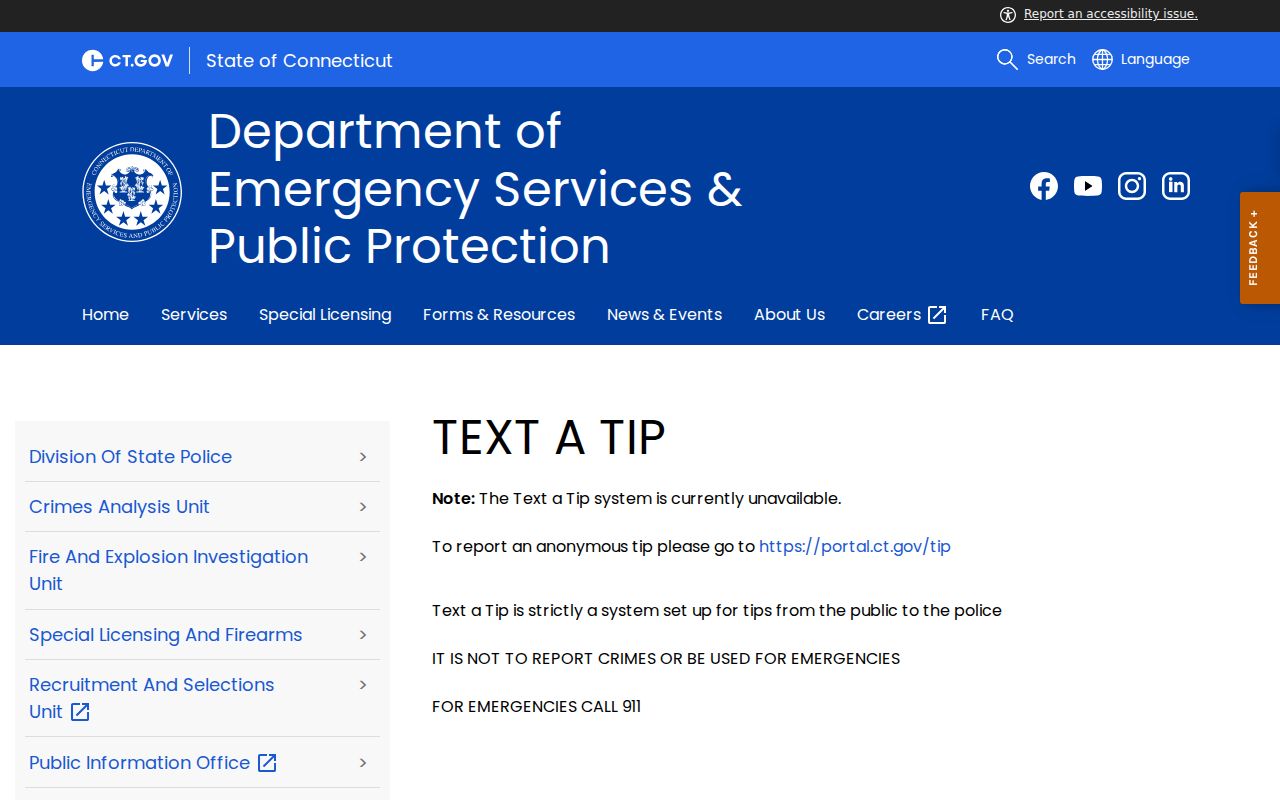
Do not mistake the redirect to a general suspicious-activity form for a personal warrant-status channel. If you may be the subject of an order yourself, only the court and the service agency can confirm it. If your information concerns a criminal investigation, use the current official contact the agency itself designates. This split avoids two common mistakes. One is treating every public tip form as a warrant reporting line. The other is expecting an agency to confirm a warrant through a public tip submission. Connecticut's own contact pages describe the purpose of each route, so read the route before you use it.
Finding Your Own Name on a Connecticut List
Finding your own name on a Connecticut most-wanted page is unsettling, but the first moves are simple ones. Do not reply to the notice, contact any listed person, or trust a third-party copy of it. Save the issuing agency and any case references instead. A lawyer can then reach the issuing court or federal office and help you plan an appearance, a motion, or another step toward resolution. For a Connecticut state case, go to the Superior Court location named in the docket or court notice, and confirm current process with its Clerk's Office. That call matters. The clerk can identify the file and walk you through the court's procedure, though the clerk cannot give legal advice. Local police or CSP can tell you what their own service records show, and in a parole matter the assigned unit and the court run the supervision process between them. Federal process is different. There, the issuing federal court and its enforcement agency hold the answers. So the right route turns on where the notice came from, not on whether the headline says "wanted" or "warrant." One more caution belongs here. A profile vanishing from a public page does not mean a Connecticut court has recalled a warrant. Keep every written order, and ask each agency whether its own record reflects the update. A public webpage can change before a court or operational record does, and no universal update interval is published anywhere in the state.
Confirm a Connecticut Warrant Safely
To run a personal Connecticut warrant check, follow a short sequence that keeps the court record separate from public fugitive pages.
- Search the limited Judicial Branch VOP page and read its scope and display notices.
- Use the pending criminal/motor-vehicle docket to identify a case number and Superior Court location if available.
- Call the assigned Clerk’s Office and ask whether the court shows a current warrant, hearing, or release condition.
- Ask the identified local police or CSP agency about its service record; the public docket does not show every agency entry.
- For federal process, consult counsel and the U.S. District Court or U.S. Marshals Service rather than the state portal.
The official Judicial Branch directory is the tool for finding a GA/JD office, and the local geography links in the Connecticut directory can orient a warrant search by town or historic county. There is no county sheriff warrant counter in Connecticut. A missing most-wanted profile proves nothing either way about whether a court order exists or stays active. Note: Use an official program contact to send a tip, and use the issuing court to confirm your own case status.