
How Connecticut Warrants Are Tracked
Connecticut organizes warrants around one Superior Court system, state and local police, and a set of public and restricted information services. The Judicial Branch issues and maintains court process. Local departments and Connecticut State Police serve criminal warrants. A limited public Arrest Warrants page lists certain VOP, FTA, and order-to-incarcerate matters. Still, that page is not the front door to the law-enforcement network; PRAWN supplies the agency workflow for authorized users. For a personal case check, search the public page and the pending criminal and motor-vehicle docket. Then confirm the court's current order with the assigned Clerk's Office. The responsible police or CSP agency keeps a separate service record. A public result, a docket, and an agency entry each answer a different question. The Connecticut Warrant Check page lays out the public channels and their limits.
Who Runs Connecticut Warrant Networks
The Judicial Branch's Criminal Justice Information System program describes PRAWN as an electronic warrant management and service network. It has an inquiry component for authorized agency users and a custodial-processing component for service and custody documents. The system is not a consumer search product, and no resident registration flow is offered. DESPP includes Connecticut State Police, which investigates and serves CSP matters and works with local partners, though DESPP does not operate PRAWN. Connecticut's public alternatives have narrower jobs. The VOP portal provides limited court-warrant information. The case lookup offers public docket context. DMV tracks license status after an eligible traffic report. Police records requests go to the state or local agency holding the covered record. None of these is a general login to every Connecticut warrant record. The Judicial Branch's official page identifies the PRAWN program and explains the system's role, showing program information rather than an agency login or any individual record. Read the official Connecticut PRAWN overview for the Judicial Branch's description.
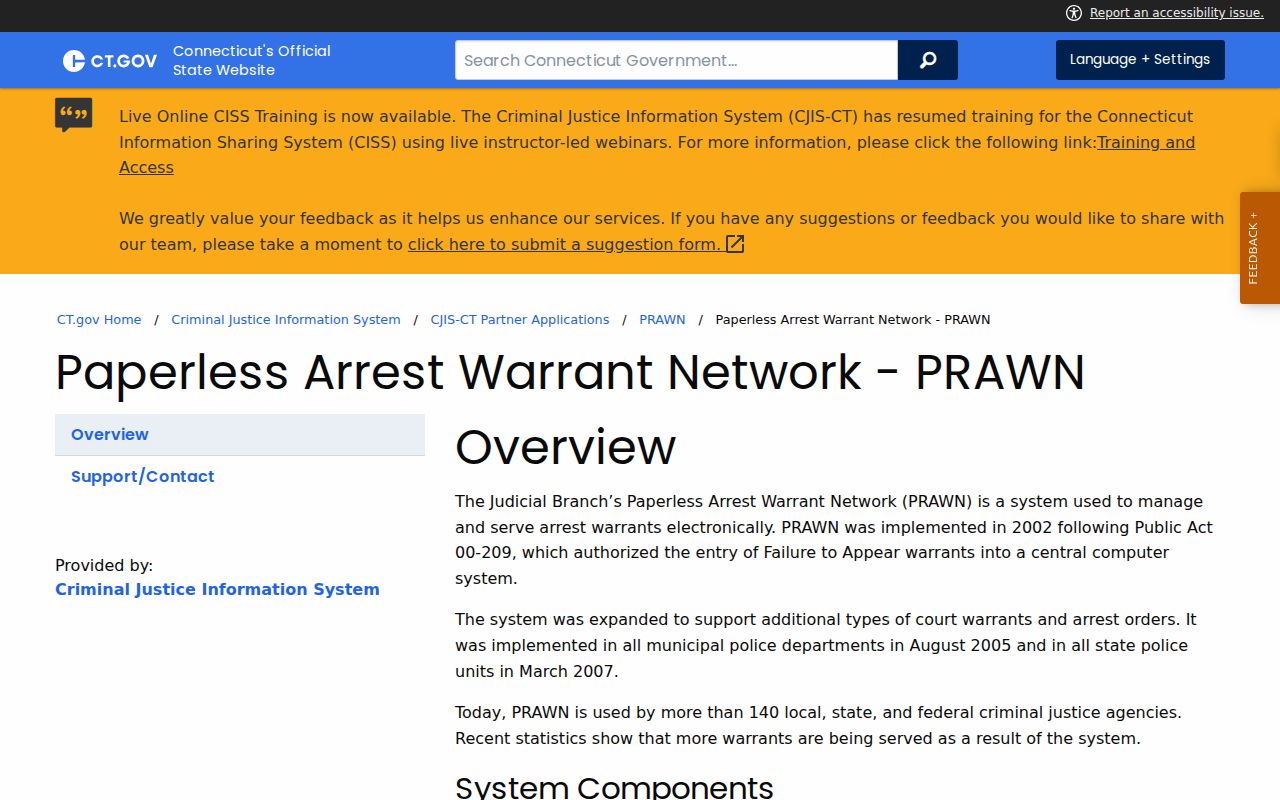
PRAWN's Inquiry and Custodial Processing functions explain why the system name appears in agency material. Yet it stays closed to anyone running a public name check in Connecticut.
The Connecticut Warrant Database
PRAWN is a restricted Judicial Branch system, not a public statewide warrant database. According to the Judicial Branch overview, a new court arrest warrant is entered through the Criminal Motor Vehicle System and sent to PRAWN immediately. Authorized criminal-justice agencies reach the network directly or through COLLECT and CISS. The FBI's NCIC is restricted as well. These connections help public-safety partners locate and process records; they create no public registration or search account for Connecticut residents.
| System or channel | What it holds | Access |
|---|---|---|
| PRAWN | Electronic court-warrant inquiry and custodial processing. | Authorized criminal-justice agencies. |
| Public Arrest Warrants page | Limited VOP, FTA, and OTI public information, with safety and youth exclusions. | Public, but FTA warrants are currently not displayed. |
| Criminal/MV case lookup | Pending public case details, court location, category, and events where shown. | Public docket search, not a warrant register. |
| COLLECT, CISS, and NCIC | Criminal-justice and wanted-person data for operational use. | Restricted agency access. |
| DMV status | Driver-license suspension or restoration information. | Public license service, not a warrant search. |
The Judicial Branch glossary says PRAWN does not include information from warrants requested by municipal and state law-enforcement agencies. So it is best described as a court-warrant workflow, not a complete inventory of every police-requested, federal, or civil order. Connecticut publishes no current public total of all active warrants.
Connecticut Warrants Are Not All Indexed
A common mistake is reading "statewide system" as a promise that every state warrant appears in one public form. Connecticut's public portal states plainly that it does not contain all warrant types. The current display notice says FTA warrants will not be displayed until further notice. The page can also omit a warrant when public posting could endanger someone, or when a youthful-offender matter is involved. And a blank search cannot show that a court recalled a warrant.
Coverage caution: PRAWN is limited to authorized users, while the public page is a defined subset. Confirm an individual Connecticut warrant with the issuing court and, separately, the responsible police or CSP agency.
A court docket is not a substitute. It can show a pending case and public events, but the Judicial Branch warns that online data is not the official court record. Police service data sits with the responsible agency. A record can be sealed, restricted, not yet displayed, or outside the search's scope. Each possibility calls for confirmation rather than inference in Connecticut.
From County Warrant to Statewide Index
No county sheriff criminal system exists in Connecticut, so records do not move from a county sheriff to a state index. The local path starts with a town and case location. The Unified Superior Court maintains the judicial case. For court-issued arrest warrants, the Judicial Branch describes a direct electronic transfer from CRMVS into PRAWN, then access for approved agencies through designated systems. Read the process as a chain, not a public search promise.
Superior Court authority issues process → Clerk’s Office maintains the case → CRMVS sends the warrant to PRAWN → authorized police/CSP or partner agencies view service data → the serving agency records action → the court records appearance, recall, or disposition.
Town police or CSP handle criminal service according to the case and the agency's role. A family-support capias follows a separate civil route that can involve a Family Support Magistrate and the State Marshal Capias Unit. A traffic case can also send a qualifying report to DMV, creating a license record distinct from any court warrant. For a personal check, ask the Clerk's Office which agency is responsible for service. County geography can orient you to the town, but in Connecticut it does not determine the agency or the court file.
Connecticut Court Locations Drive Routing
Connecticut runs its criminal cases through one Superior Court system. Judicial District locations take the major criminal matters. Geographical Area courts handle arraignments, misdemeanors, motor-vehicle matters, and many other criminal cases. Hartford and Waterbury Community Courts belong to the Superior Court too. The Clerk's Office at the GA or JD keeps the case file, and it can route a question about the court's current order. On the service side, a town points to its police department or a State Police troop. Some Connecticut municipalities run local departments; others rely on CSP through resident-trooper or barracks coverage. No one statewide warrant phone line covers every town. Use the official Judicial Branch directory to find the assigned court. Then ask the Connecticut clerk to confirm the agency responsible for service. Marshals add one more split. Connecticut State Marshals serve civil process and certain civil capias orders. Judicial Marshals handle courthouse security and prisoner transport. Neither one is a county sheriff criminal warrant office.
Federal Fugitive Warrants in Connecticut
Federal warrants move on a separate court and enforcement chain. Connecticut forms one federal judicial district. Federal criminal warrants issue under federal process. The U.S. Marshals Service serves them or coordinates with authorized partners. The District of Connecticut website posts court and location information. PACER opens public federal docket filings. Neither one lets the public self-query an unserved warrant, and sealed or unfiled material may not appear. The U.S. Marshals District page names the Connecticut Violent Crimes Fugitive Task Force. It lists offices in New Haven, Bridgeport, and Hartford, plus a public task-force contact. That task force is a federal program. Its contacts will not confirm Connecticut Superior Court process or run a statewide warrant search for a resident. Open the official District of Connecticut court page for the court's own access information.
This court page gives federal court context only. It is not a Connecticut warrant list. For filings, use the official PACER service, which opens public federal docket records. Its entry page is a docket-search starting point, not a warrant-status form.
PACER shows filed public case material. A sealed or unfiled warrant stays off it, and so does the NCIC status held by law enforcement. Keep state and federal questions apart. Confirm a state case with the issuing Connecticut Superior Court and local police or CSP; take a federal case to the federal court and counsel.
What 140 Connecticut Agencies Means
The "more than 140 agencies" figure on the PRAWN program page counts local, state, and federal criminal-justice partners that use the network. It is not a tally of Connecticut warrants. It is not a count of counties either. Nor does it measure offices with public lists or records the public can search. The Judicial Branch describes authorized inquiry and custodial processing. No resident account exists. No public agency inquiry tool is offered either. The public footprint is narrower. The VOP page holds a limited public set, with the current FTA suppression notice and its safety and youth exclusions. A criminal docket search adds public case context. Local police and CSP keep their own service data. There is no official public count of all active Connecticut warrants. Neither the 140+ agency measure nor aggregate FTA reports can tell you whether one person has a warrant.
Read the figure accurately: PRAWN measures agency access to a restricted workflow. It does not measure warrant records or public search coverage.
Need a case-specific answer? Call the assigned Clerk's Office to verify the court order. Then ask the responsible service agency about its record, and for broader patterns use a date-labeled Judicial Branch aggregate report while keeping its definition in mind.
Statewide Index vs Connecticut County Warrants
Connecticut sheriffs run no county warrant lists. The useful split is different. Compare the statewide court and agency systems against the public records tied to one town and its assigned court. PRAWN supplies restricted agency inquiry and service functions. The limited Judicial Branch portal is public but incomplete; local police may keep or publish agency-specific information, while the court holds the judicial status and the related docket.
| Question | Public/statewide view | Case custodian |
|---|---|---|
| Does a limited VOP/FTA/OTI entry appear? | Search the Judicial Branch public page, noting exclusions and the current FTA notice. | Confirm with the assigned Superior Court clerk. |
| What case and court location are listed? | Use the pending criminal/MV docket when public details are available. | The court file is the official record. |
| Which agency has a service record? | There is no public PRAWN or full-state police query. | Ask the police/CSP agency identified by the court. |
| Is a license suspended? | Check the separate DMV status or notice route. | DMV reflects license privilege, not warrant recall. |
County lines only orient you geographically. The working route follows the town, the GA/JD court, and the agency assigned to serve the order. Use the Connecticut directory for historic counties plus city and town destinations. County labels there are not criminal jurisdictions.
Connecticut DMV Holds Are Different
Connecticut handles traffic failures differently from many states. There is no statewide commercial FTA license-hold program here. Under C.G.S. §14-140, a Connecticut court can report a qualifying traffic failure to DMV. DMV sends a notice. It also gives a defined path to reopen. After a suspension, a reinstatement payment may be required. That system concerns driving privilege alone. It sits apart from PRAWN, public warrant data, and police service records. The public Connecticut DMV page posts current suspension and reopening directions, while a case-specific court order, a CIB ticket result, and license status each need their own check. Paying a DMV fee will not recall a warrant. Paying or reopening a ticket does not end a separate criminal FTA process. For a traffic matter, ask the issuing court about the docket and warrant, and DMV about the license. Connecticut also changed the notice and reopening rules through Public Act 25-159, which covers a defined group of infractions and violations. Its seven-year dismissal provision is narrow. It is not a rule that every warrant in Connecticut expires after seven years, so ask the court whether the statute applies to a particular case.
How Connecticut Warrant Systems Went Digital
Connecticut's PRAWN went live in 2002. Public Act 00-209 started the shift toward central computer handling of failure-to-appear warrants. The Judicial Branch says every municipal police department was live by August 2005. State Police units followed by March 2007. The system later grew to cover more court warrant types and electronic custody processing. More than 140 local, state, and federal criminal-justice agencies now use it. That figure counts agencies with access, not warrant volume. It is not full data coverage. The OPM municipal series offers historical aggregate counts for 2006 through 2016, not a current name search. Current Judicial Branch statistical reports are period measures too. They can describe patterns across Connecticut, but they cannot certify whether one person's warrant remains active. For report links and definitions, review the Judicial Branch FTA statistics and glossary, a page of reports and terms rather than warrant files.
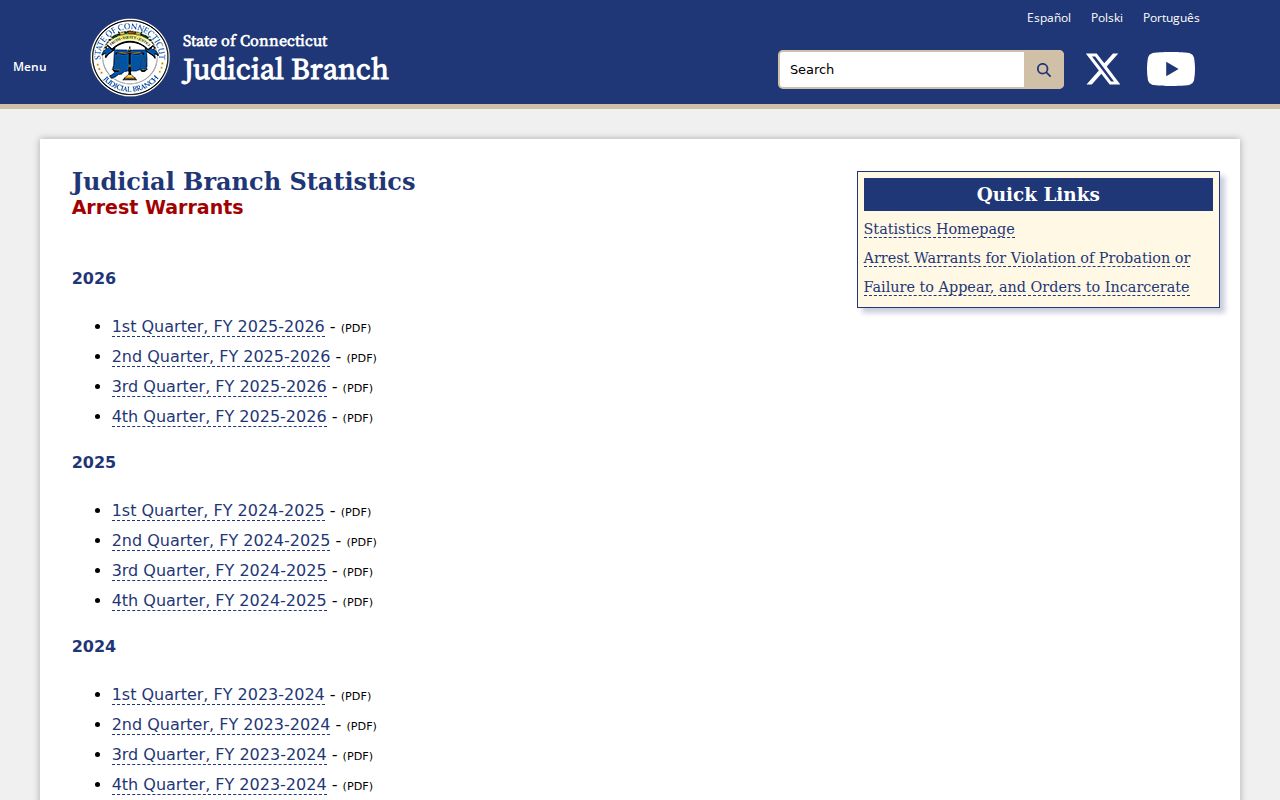
These are statistical resources for Connecticut. Their page connects no one to PRAWN and exposes no restricted agency warrant files.
Confirm a Connecticut Warrant System Record
Treat any public search hit as a lead only. Carry the record to the office that can actually confirm a Connecticut warrant: the issuing court or the serving agency.
- Search the limited VOP page and note its current scope or no-display notices.
- Use the public criminal/motor-vehicle docket to identify the case and GA/JD location.
- Call the assigned Superior Court Clerk’s Office to confirm judicial status and next steps.
- Ask the responsible local police/CSP agency to check its own service record.
- For a traffic matter, handle court reopening and DMV license status as separate tasks; for federal process, use the federal court and counsel.
The Connecticut PRAWN support contact serves authorized agencies needing technical help. It does not give personal warrant status. DESPP's GovQA page takes certain report-copy requests and lists a $16 case-related search fee. It is not a live warrant lookup either. A personal case question about a Connecticut matter belongs with the issuing court, not those offices. Keep any recall, reopening, or disposition order. Ask whether the serving agency has entered the update, since public pages and agency systems share no universal refresh time.